Ch 6. Work Problems---Quiz 7: Questions? email nalexander@igc.org
Helpers!! Click this link then click the links "Practice Questions" and "Practice Problems" in the left hand column.
WF = Fd.
WN = Wg = Ws =Wf = 0 .
(a)
KEi = 0 since Vi = 0.
Set Fd = KEf. Find Vf.
(b) Wf = -fd where f = µN. What is the normal force magnitude N?
Wf + WF = KEf - KEi .
KEi = 0 since Vi = 0.
Find Vf.
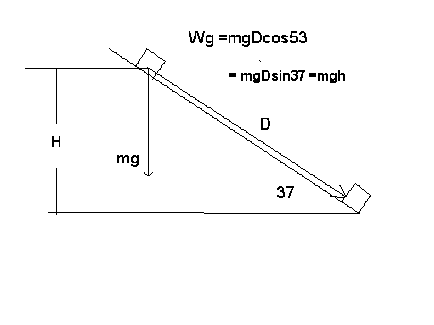
(a) High to low means Wg = +mgh.
(b) Wg = +mgh = KEf - KEi .
KEi = 0 since Vi = 0.
Set mgh = KEf. Find Vf.
Wnet = WN + Wg + Ws + Wf + WF = KEf - KEi
WN = WF =Ws =Wf = 0 .
High to low means Wg = +mgh.
h = L sin 36.9, where L = 0.750 m.
+mgh = KEf - KEi .
KEi = 0 since Vi = 0.
Find Vf.
(a)
WF = KEf - KEi .
KEi = 0 since Vi = 0.
Note that the force of magnitude F is not constant, so you have to integrate to get the answer.
From 0 to 8 m, WF = area under the curve of the triangle of height 10 N and base 8 m.
Find Vf.
(b)
WF = KEf - KEi .
KEi = 0 since Vi = 0.
You have to integrate to get the answer.
From 0 to 12 m, WF = area under the curve of the triangle of height 10 N and base 12 m.
WF = KEf - KEi .
KEi = 0 since Vi = 0.
Find Vf.
(a) Total Work = Ws, where Ws = work of spring, which is positive. Ws = ½ kx12 - ½ kx22 . Note: x2 = 0.
(b) Total Work = change in KE = ½ mv22 - ½ m2v12 . Find the second speed. The first speed = 0.
(a) Total Work = change in KE = ½ mv22 - ½ m2v12 . The initial and final speed are given.
(b) Total Work = WF + Wg, where WF = work by your force F on the pedals. Wg = -mgh. Solve for WF .
81.
(a) Total Work = Ws, where Ws = work of spring, which is negative. Ws = ½
kx12 - ½ kx22
. Note: x1 = 0.
Total Work = change in KE = ½ mv22 - ½ m2v12
. v1 is given and v2 = 0. Find the
value x2.
(b) Total Work = Ws = change in KE = ½ mv22 - ½ m2v12
. Find the first speed. The second speed = 0.
82. WTot = ½ m1v2
+ ½ m2v2
Wf + Wg = ½ m1v2 + ½
m2v2
-ukNh + m2gh = ½ m1v2
+ ½ m2v2
m1 = 8.00 kg and m2 = 6.00 kg
What is N ? Hint: It is the N for m1. Solve for v.
Note that the work by tension for m1 is T·h and the work by
tension for m2 is -T·h. So these works cancel.
Think about it !!