(f) (12 points) What is the depth D of the lake ?
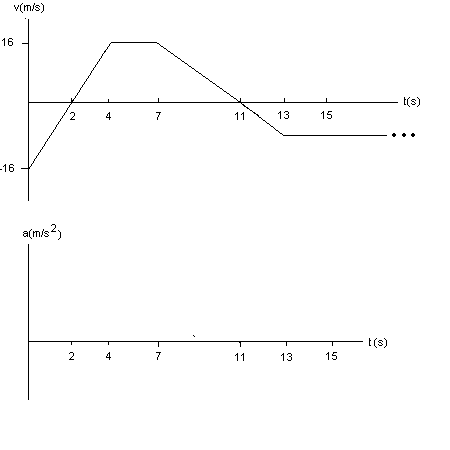
1. (26 points) The one–dimensional motion of a skateboard rider is shown below in the graph of the instantaneous velocity v vs. t. Assume for the purposes of this problem that the positive direction of motion is rightward along the x-axis. Note: At 13 seconds, the velocity reaches a value of -8 m/s and remains constant for t > 13 seconds.
(1 point) What direction is the rider moving between 0 and 2 seconds, rightward or leftward?
(1 point) What direction is the rider moving between 2 and 4 seconds, rightward or leftward?
(1 point) What direction is the rider moving between 4 and 7 seconds, rightward or leftward?
(1 point) What direction is the rider moving between 7 and 11 seconds, rightward or leftward?
(1 point) What direction is the rider moving between 11 and 13 seconds, rightward or leftward?
(1 point) What direction is the rider moving between 13 and 15 seconds, rightward or leftward?
(2 points) At what times does rider the come to a stop?
(6 points) Sketch the acceleration a of the rider on the axes below the v vs t curve. Label the vertical a axis with the correct values of the accelerations in the appropriate time intervals, which are aligned with the times for the v vs t curve.
(12 points) Calculate the average velocity of the rider between 0 and 15 seconds. Show all steps. Write clearly, carefully and neatly. Box your answer. Thanks.
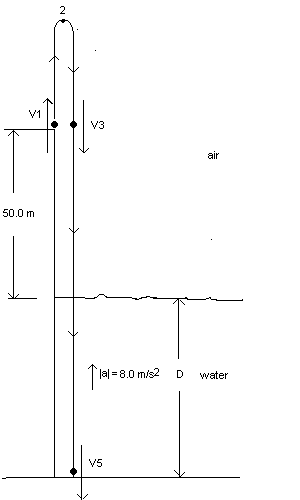
2. ( 22 points) This problem deals with a building in a flooded region of a tropical country. A ball is thrown from the top of the building whose roof is 50.0 m above the surface of a lake created by heavy rainfall. The initial speed is |v1| =
20.0 m/s. The ball follows the one-dimensional trajectory schematically shown.
Assume the magnitude of gravitational acceleration is g = 9.80 m/s2.
The ball hits the water surface and moves downward to the bottom of the lake with a upward acceleration whose magnitude is |a | = 8.00 m/s2. Thus, it slows down in the water. Just before it hits the bottom of the lake, the speed is |v5| = 20.0 m/s. (Scales shown in the schematic diagram below are not necessarily accurate to the parameters of the problem.)
(a) (2 points) What is the speed |v2 | at point 2 at the top of the trajectory ?
(b) (2 points) What is the magnitude |a | of the acceleration at point 2 at the top of the trajectory ?
(c) (2 points) What is the time that it takes to reach point 2 at the top of the trajectory ?
(d) (2 points) What is the speed |v3| when the ball returns to the level of the roof ?
(e) ( 2 points) What is the time that it takes to return to the level of the roof ?
(f) (12 points) What is the depth D of the lake ?
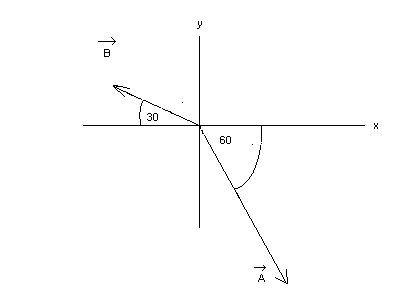
3. ( 22 points) The 2 vectors are oriented as shown in the figure below.
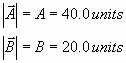
Find:
(a) (6 points) the x and y components Rx and Ry of the resultant vector given by:

(b) (4 points) The magnitude R of the resultant vector.
(c) (4 points) The direction of the resultant vector. What is the related angle with the x-axis? In what quadrant does the resultant vector point? Make a sketch of the resultant on the axes provided labeled (c). Show the related angle in the sketch.
(d) (4 points) the x and y components Dx and Dy of the difference vector given by:

(e) ( 4 points) The direction of the difference vector. What is the related angle with the x-axis? In what quadrant does the resultant vector point? Make a sketch of the resultant on the axes provided labeled (e). Show the related angle in the sketch.
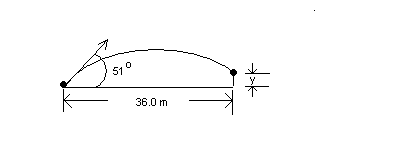
Extra Credit (8 points) A prospective Oakland Raider on try-out must kick a football from a point a horizontal distance 36.0 m from the goal. When kicked, the ball leaves the ground (y = 0) with a speed of v0 = 20.0 m/s at an angle of 51 0 to the horizontal.
(a) (4)How long does the ball take (in seconds) to move the horizontal distance
36.0 m ?
(b) (4)What is y after it travels that horizontal distance of 36.0 m ?