|
40.
Solve for x. 2(2x -2) =
64. (Hint: Write 64 as 2 raised to a power.) The value of x is in the ranges below:
|
|
a (0,3)
|
| b (3,6) |
|
c (6,9)
|
|
d (9,12)
|
|
e nota
|
|
41. 4x = 32 Solve for x. (Hint : Write 4 as 2
raised to a power. Write 32 as 2 raised to a power.) x is in the range:
|
|
a (0,2)
|
|
b (2,4)
|
|
c (4,6)
|
|
d nota
|
|
42. Solve for x . 9ex = 900. (Hint : First
divide both sides by 9. Note: ln = loge. ) |
| a x = log9 100
|
|
b x = log 100 |
|
c x = ln 110 |
|
d x = ln 100 |
|
e nota
|
|
43. Solve for x. log3x = 5. (Hint: Write in
exponential form. Solve for x.) |
| a x = 81 |
|
b x = 243 |
|
c x = 27 |
|
d nota
|
| 44. Solve for x. log5(x
- 1) = 2. (Hint: Write in exponential form. Solve for x.) |
| a x = 12 |
|
b x = 22 |
|
c x = 32 |
|
d x = 26 |
|
e nota
|
| 45. Rewrite the following in
exponential form: log6(x - 1) + log6x
= 1.
(Hint: Write the sum as the log of a product.)
|
| a ( x - 1) + x =
6 |
| b ( x - 1)·x = 6 |
| c ( x - 1)·x = 36 |
| d ( x - 1)·x = 1 |
| e nota
|
| 46. Solve for x in the previous
problem. x is in the following ranges:
|
|
a (-10, 0) or ( 0, 2) |
|
b (-5, 0) or (0,4) |
|
c (0,5) or (5,10) |
|
d nota |
| written problems |
47. Solve for x: log3(x
- 5) + log3(x + 3)
= 2.
Hint: Rewrite as log3(x - 5)·(x
+ 3)
= 2. Then write in exponential form. |
| 48. Solve for x. log(2x -
1) - logx
= 2. Log means log base 10. Subtraction must be converted to log
of the quotient. Once you do that, convert to exponential notation, then
cross multiply. |
| 10.1 |
| 49. Find the distance d between the
points (-2,-1) and (1,3). |
| 50. Find the midpoint between the
points (-2,-1) and (1,3). |
51. Find the center and radius
of the circle given by the equation here.
(x - 1)2 + (y - 2)2 = 25. |
52. Find the center and radius of the circle given
by the equation here.
x2 + y2 + 6x + 2y + 6 = 0.
Hint:
# Rewrite the equation as x2 + 6x + y2
+ 2y + 6 = 0.
#Then complete the square twice for the terms that are in brackets:
(x2 + 6x ) + (y2 + 2y ) + 6 = 0
# After completing the square twice, factor the terms in brackets, collect like terms, and isolate the
numbers to the right hand side. |
|
53. Sec. 8.4. Solve for x: x4
- 9x2 + 20 = 0. (Hint: Let: u = x2) |
54. A problem for you visual learners. Sketch the inverse of the
function below. Label the intercepts of the inverse.
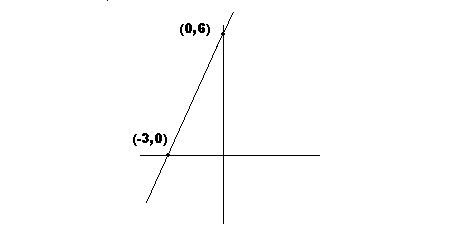
|
55. Solve by completing the square:
x2 + 10x = 24. |
56. Solve by completing the square:
x2 - 12x = 28. |
| 8.2 |
| 57. Solve using the quadratic
formula.
x2 + 3x + 1 = 0 |
| 58. Solve using the quadratic formula.
x2 + 3x - 8 = 0 |
| 59. Compute the discriminant x2
+ 3x + 7 = 0. How many solutions are there? Are they real or imaginary? |
|
60. What are the solutions in the previous problem? ( In other words,
solve for x in the previous problem using the quadratic equation.)
|
|
Extra credit |
|
61. Solve for x. log2x = 5. (Hint: Write in
exponential form. Solve for x.)
|
|
62. Solve for x. log3x = 3. (Hint: Write in
exponential form. Solve for x.)
|
|
63. Solve for x. log39 = x (Hint: Write in
exponential form. Solve for x.)
|
|
64. Solve for x. log216 = x (Hint: Write
in exponential form. Solve for x.)
|
|
65. Solve for x. 2(2x -4)
= 32
(Hint: Write 32 as 2 raised to a power.) |
|
66.
Simplify: 642/3 |
|
67. Simplify: 82/3 |
|
The following problems would not be Extra Credit. They would be
required. They are from Appendix G. |
68. Complete the in the table for the function y = 1/x:
| x |
y |
| 1 |
|
| 2 |
|
| 3 |
|
| -1 |
|
| -2 |
|
| -3 |
|
| 1/2 |
|
| 1/3 |
|
| -1/2 |
|
| -1/3 |
|
|
|
69. Plot the graph of the previous problem. |
70. Complete the in the table for the function y = 2/x:
| x |
y |
| 1 |
|
| 2 |
|
| 3 |
|
| -1 |
|
| -2 |
|
| -3 |
|
| 1/2 |
|
| 1/3 |
|
| -1/2 |
|
| -1/3 |
|
|
|
71. Plot the graph of the previous problem. |
|
|