|
2B SP ‘09 |
|
PHOTOELECTRIC EFFECT |
|
9. ( 10 points) What is the
energy in Joules (J) of photons
emitted by radio station KQED
FM, frequency f = 88.5 MHz? Note: 1 MHz = 10 6
Hz and h = 6.63x10 -34 J·s. |
|
10. (15
points) The longest wavelength of light that will emit electrons from a
certain metal is λ =
402 nm. (c ) (7 points) What would
be the kinetic energy (in Joules) of an emitted electron if the incident
light had wavelength λ = 201 nm? |
|
ATOMIC |
|
11. (12
points) For the two hydrogen
transitions (i) and (ii) indicated below, n is the initial state and n’ is the final
state.
(a) (3 points) Which transition involves the largest
energy photon, (i) or (ii)? Circle
one.
|
|
4C FALL ‘98 PHOTOELECTRIC EFFECT |
|
2.
(20 points) (b) (10 points) What is the work function
|
|
2B SP ‘99 ATOMIC |
|
7. ( 20 points) (a)(10 points) If an electron makes a transition
from the n = 3 Bohr orbit to the n =1 orbit in hydrogen, find the wavelength
of the photon created in this process. (b)(10 points) Assuming that the atom was initially
at rest, find the recoil speed of the hydrogen atom when this photon is
emitted. HINT: USE CONVERSATION OF
MOMENTUM; IGNORE THE ELECTRON MASS |
|
4C SP AU ‘01 PHOTOELECTRIC EFFECT |
|
3. (20 points) Summary
problem from
|
|
2B SP’11 PHOTOELECTRIC
EFFECT |
|
7. (12 points) When
a beam
of UV (ultra violet)
radiation, wave length 285 nm,
falls on a metal surface, the
maximum kinetic energy of emitted
electrons is KE = 5.20x10 – 19 J.
Note: h = 6.626x10 -34 J· s. |
|
2B SP ’08 |
|
PHOTOELECTRIC EFFECT |
|
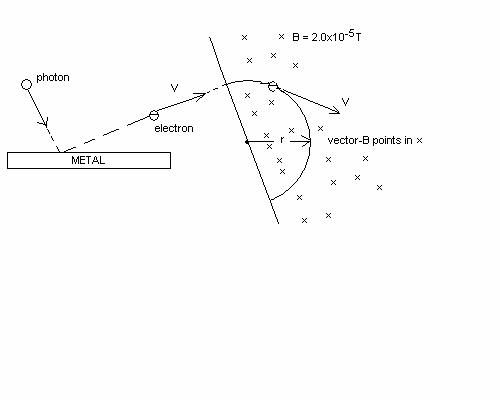
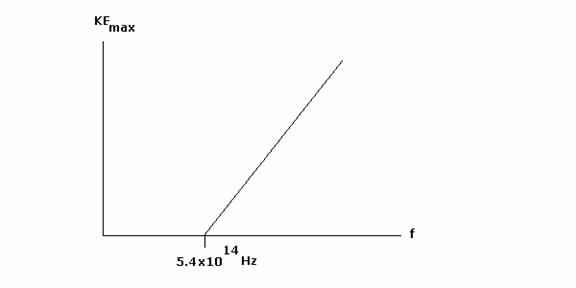
3. (30 points) Light is shined on a metal surface. As indicated below, electrons are ejected
only if the incident light has a
frequency that is at least equal to 5.40 x 10¹⁴ Hz. ---------------------------------------------------------------------------- 4 (20 points) ATOMIC ------------------------------------------------------------- 5. (20 points) ATOMIC |
|
4C SP ‘02 |
|
PHOTOELECTRIC EFFECT |
|
2. (a) (28 points) This
problem deals with the photoelectric effect. The stopping potential for
photoelectrons emitted from a surface illuminated by light of wavelength =
487 nm is V = 0.698 V. At what incident wavelength is the stopping potential equal to zero? (b) (2 points) Circle the
correct answer: Who invented the photoelectric effect? (1) Bill Gates (2) Einstein (3) Hertz
(4) Maxwell (5) Planck |
|
4C SP ‘04 |
|
ATOMIC |
|
5. (22
points) A hydrogen atom, initially in the ground state (ni
= 1) absorbs a photon of wavelength 122.00 nm. (b) (8) EXTRA CREDIT : What
is the maximum value of
(c) (2) EXTRA CREDIT: In units of
|