|
|
|||||||||||||||||||||||||||||||||
|
1. Ce - x/L
for
x SOLUTIONS: (a) INTEGRAL OF C2e-2x/L dx from 0 to infinity = 1 or C2*(L/2)[1 - 0] = 1 Thus C = sqrt(2/L) = 4.47x10 12 m -1,
a classic result. |
|||||||||||||||||||||||||||||||||
|
SOLUTIONS: (a) 0.0013 = Ge-2k'L , E/Uo = 32/41 = 0.780
in the formula for G. Thus: L = 0.25 nm. |
|||||||||||||||||||||||||||||||||
3. CH. 40. STEP FUNCTION POTENTIAL DESCRIBED BY #35,
QUIZ 7.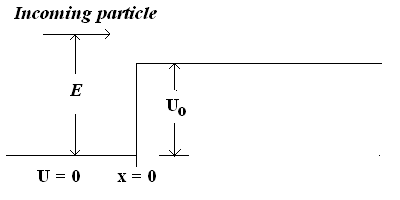 Particles incident from the left are confronted with a step in potential energy. See #35, Quiz 7. Classically, all the particles would pass into the region of higher potential. But according to Quantum Mechanics, a fraction of the particles are reflected at the barrier. This problem is analogous to the partial reflection and transmission of light striking an interface between two different media covered in Physics 4C. Suppose a particle with kinetic energy E = 7.00 eV is incident from a
region where the potential energy is zero onto one in which Uo
= 3.50 eV. HINT: (a) USE THE RESULT OF #35, Quiz 7, AND COMPUTE |B|2/|A|2
'Transmission and reflection through potentials' and also'Examples' dealing with 'Plane wave' just below it.----------------------------------------------------------------------------------------------------------- SOLUTIONS: A = (1/2)*[1 + k'/k]*C = (1/2)[k +
k'](C/k); thus C = 2Ak/[k + k']
|
|||||||||||||||||||||||||||||||||
|
4. CHAPTER 41: THE HYDROGEN ATOM: IT MAY BE HELPFUL TO USE THE
WAVELENGTH EXACTLY AS WRITTEN , KEEPING ALL THE SIGNIFICANT DIGITS
GIVEN.
(23 points) A hydrogen atom in the 2nd excited state (n =3) absorbs an infra-red photon of wavelength 1874.606 nm. (a) (10 points) Determine the maximum possible orbital angular
momentum of the electron after the absorption. Note: The
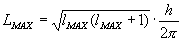
orbital angular momentum is given by the formula: Solving,
nf = 4. That means lMAX = 3, and thus LMAX
= sqrt(12)*hbar
|
|||||||||||||||||||||||||||||||||
|
5. (25 points) HYDROGEN ATOM: Consider the ground-state wave function for hydrogen below and in the textbook. (a) (10 points) Show the wave function as written is normalized. (b) (10 points) Find the probability of locating the electron between r1 = ao/2 and r2 = 3ao/2. 
Based on your answer to part (b) what is the probability the electron is found outside the region of part (b)? ------------------------------------------------------------------------------------------------------ SOLUTIONS: (a) Go here: http://hyperphysics.phy-astr.gsu.edu/hbase/quantum/hydrng.html#c1
(c) 1.000 - 0.497 = 0.503 = 50.3 % |
|||||||||||||||||||||||||||||||||
|
6. CH. 41 ZEEMAN EFFECT:
A hydrogen atom undergoes a transition from a 3d state to a
2p state.
(c) (6 points) Two observed wavelengths are exactly the
same with the magnetic field as without. What are the initial and
final ml values for each transition that produces a photon of
this wavelength? SOLUTIONS: |
|||||||||||||||||||||||||||||||||
|
7. (15 points) XRAY PHOTONS: A K-alpha X-RAY is emitted from a sample with energy 1.2536 KeV . (a) (10 points) Of which element is the sample made? (b) (5 points) List the steps leading to the emission of the x-ray photon. Include why the photon was emitted and the atomic transitions leading to the photon emission. What was the initial state of the transition? What was the final state? Why was there a vacancy in the final state allowing it to be filled by an electron from a higher energy state? Also explain key factors in the formula you used to find information identifying the element; why is (Z -1) used in the formula ? ------------------------------------------------------------------------------------------------------ SOLUTIONS: (a) See equation 41.30: 1.2536x10 3 eV = (Z -1)2*(10.2 eV); this yields Z = 12, for Mg aka magnesium. (b) Electron from a beam knocks an atomic electron out of the n =1 orbital and another electron "falls" from an atomic n = 2 state into the vacancy. The "falling" electron sees a nucleus partially shield by the other electron in the n = 1 state . |
|||||||||||||||||||||||||||||||||
|
8. MOLECULAR SPECTRA (a) (10 points) For NaCl, three successive wavelengths for rotational transitions are 23.1 mm, 11.6 mm, and 7.71 mm. Calculate the moment of inertia of NaCl. (b) (5 points) What is the bond length of NaCl? (c) (10 points) Photons of what frequency can be spontaneously emitted by CO molecules in the state of vibrational number n = 1 and rotational number l = 0? ------------------------------------------------------------------------------------------------ SOLUTIONS: (a) THIS WAS THE MOST DIFFICULT PROBLEM OF THE ENTIRE ASSIGNMENT, JUDGING FROM STUDENT ANSWERS SURVEYED; that is why your extra credit opportunities in Ch. 43 may help a little. Erot = l(l +1)*hbar2 /(2I). The ALLOWED CHANGE in energy is between 1 and l + 1 or l and l - 1, SINCE A PHOTON CARRIES AWAY (OR GIVES) ONE UNIT OF ANGULAR MOMENTUM. In either case, the difference may be algebraically shown to be E(l +1) - E(l) = (hbar2*l)/I, where l = 1, 2, 3, 4, ...... NOTE: l = 1 in the series refers to a transition from l = 1 to l = 0. We see the slope of the line is hbar 2/I and the change in energy is linearly proportional to l: slope = hbar 2/I = [hc/lambda2 - hc/lambda1 ]/(change in l), where you may choose two lambdas, designated as lambda1 and lambda2 . Remember to divide the numerator by the (change in l). FOR EXAMPLE, LET lambda1 = 23.1x10 -3 m and lambda2 = 11.6x10 -3 m ; in this case we see the (change in l) = 1, since the wavelengths are adjacent and represent successive transitions which change l by one, the selection rule for rotational state changes: hc/(11.6x10 -3 m) - hc/(23.1x10 -3 m) = 0.854x10 -23 J = hbar 2/I . This gives I = 1.29x 10 -45 kg-m2. (b) I is given by formula 42.5: I = mrro2 , where = mr = m1*m2/(m1 + m2). This gives = 2.36x10 -10 m. (c) WE TURN OUR ATTENTION TO CARBON MONOXIDE, THAT NOXIOUS COMPOUND POLLUTING OUR AIR. The initial state is n = 1 (vibrations) and l = 0 (rotations) is the initial state. Remember the selection rules are change in l = +1 or -1 and (change in n) = +1 or -1. In the case of photon emission, we know the molecule has (change in n) = -1, which means it drops into the n = 0 state. In that case, l = 1 for the final state. See figure 42.8 which shows an n = 2, l = 0 state dropping into an n = 1, l =1 state for a nice analogy our case of an n = 1, l = 0 state dropping into an n = 0, l = 1state. If you see the absorption spectra for rotational molecules, we see the molecules can either gain or lose one unit of angular momentum l as well. Thus, logically, the emission spectrum would also have a gain or loss of one unit of angular momentum.
Evaluate Ei - Ef = hbar*w - hbar2 /I. MANY STUDENTS NEGLECTED THE SECOND NEGATIVE TERM, WHICH WILL CHANGE YOUR ANSWER BY A NEGLIGIBLE FRACTION, WHICH YOU SHOULD HAVE DEMONSTRATED FOR FULL CREDIT. Ei - Ef = hbar*w - hbar2 /I = 0.2690 eV - hbar2 /I = 0.2690 eV - 0.000479 eV which still is approximately 0.2690 eV; you should include both vibrational and rotational terms and show the rotational energy change is much, much smaller than the vibrational energy change to justify neglecting the former. See example 42.2 for explicit computation of the rotational energy term; meanwhile it is easy to show hbar*w = 0.2690 eV as example 42.3 explicitly states, from which you can get k' = 1902 N/m and then work backwards to get w and hence hbar*w = 0.2690 eV. Now set hf = 0.2670 eV , from which we get f = 6.5 x10 13 s-1
(Hz), using h = 4.136x10 -15 eV-s. |
|||||||||||||||||||||||||||||||||
|
9. SIMPLE COMPUTATIONS AND BUILDING INTUITION WITH THE
FERMI -DIRAC DISTRIBUTION: For a solid metal,
(a) (10 points) what is the probability at room temperature
(T = 300 K) for an electron to have energy 0.10 eV
above the Fermi energy? In other words, what is the probability that a
state with this energy is occupied? (d) SEE EXAMPLE 42.7: IF f(E) =
1/(e(E-EF)/kT + 1) = 0.950 , THEN, E = EF + kT*ln[1/f(E) - 1] = 5.48 eV + (8.625 x10 -5 eV/K)(800 K)*ln[1/0.950 - 1] = 5.48 eV + (0.025875)*ln(1.0526 - 1) = 5.48 + (0.069)*(-2.94444) = 5.48 - 0.076187 = 5.28 eV. (e) 0; see figure 42.24 and 42.25. (f)
1; see figure 42.24 and 42.25.
|
|||||||||||||||||||||||||||||||||
|
10. ENERGY BANDS AND SEMI-CONDUCTORS: (10 POINTS) The gap between the valance and conduction bands in Silicon is 1.12 eV. A radioactively "hot" nickel nucleus in an excited state emits a high energy gamma ray photon with a wavelength 9.00x10⁻⁴ nm. How many electrons can be excited from the top of the valence band to the bottom of the conduction band by the absorption of this gamma ray? ------------------------------------------------------------------------------------------------ SOLUTIONS: hc/lambda = Energy = n*1.12 eV, where n is the number of electrons excited into the valance band; for the given wavelength lambda, we get n = 1.24x10 6 electrons |
|||||||||||||||||||||||||||||||||
|
11. SEMI-CONDUCTOR DEVICES. Last time we reviewed how the a p-n junction is
characterized by a space charge region, the result of the diffusion of
electrons from the n side to the p side. Visit: http://en.wikipedia.org/wiki/P%E2%80%93n_junction . This diffusion ceases when an opposing electric force cancels out the "diffusion " force. That force is caused by an electric field from the two adjacent oppositely charged layers, one negative (on the p side, from the build up of electrons) and the other positive (on the n side, from the removal of electrons). In order for positive current to flow into the p-side, the net electric field must be reduced by an oppositely directed field set up by an external battery whose positive terminal is connected to the p-side in what we call "forward bias." (a) (10 points) A forward bias voltage of 15.05 mV produces a positive current of 9.24 mA through a p-n junction at 300.00 K. What is the positive current to become if the forward-bias voltage is reduced to 10.00 mV? (b) (5 points) In reverse bias, the battery's negative terminal is connected to the p-side. For reverse bias voltages of -15.01 mV and -10.02 mV, what is the reverse-bias negative current? ------------------------------------------------------------------------------------------------ SOLUTIONS: Use equation I = Is*(eeV/kT -1); see figure 42.31, which shows a current rising dramatically in forward bias and very gradually at reverse bias. If we had time, we would compute the "cut-off" voltage when the current begins to rise dramatically with very large slope. That computation is easy when you determine criteria on the slope. (a) First you need to get factor Is , know as the saturation current, using information given: I = 9.25 mA when V = 15.05 mV. That gives Is = 0.0117 (A), in turn giving I = 5.53 mA when V = 10.00 mV. We reduced the voltage by 33 % and got a reduction in current of some 40 %. It appears we were below the "cut-off " voltage shown in figure 42.31, which shows a much more dramatic variation of current with voltage at larger values of potential. (b) Now that you know the saturation current Is, the rest is easy: Plug in the two values of voltage and you a negative current I, consistent with figure 42.31. I = -5.16 mA when V = -15.01 (mV) I = -3.75 mA when V = -10.02 (mV) We reduced the voltage by 33 % and got a reduction in current of nearly 38 % . In figure 42.31, going in the negative potential direction it appears we are in the region of the graph before the curve flattens out at larger magnitude negative voltages. |


 .
. 