| REAL TEST 3 P5, SP12 |
|
1. (22 points) ZERO-POINT ENERGY: For more info
visit: http://en.wikipedia.org/wiki/Zero-point_energy
or http://hyperphysics.phy-astr.gsu.edu/hbase/quantum/hosc4.html#c1 .
(b) (7 POINTS) For the value of Δx you got in part (a), what is the ratio of the kinetic
energy to the potential energy of the particle? (c ) (3 POINTS) Explain why
the value you got for the minimum energy is higher than that obtained
at this link: http://hyperphysics.phy-astr.gsu.edu/hbase/quantum/hosc4.html#c1 . ------------------------------------------------------------------------------------------------------- 2. (23
points) Consider a finite square well. The potential energy is Uo = 6E1box , where E1box is the ground state energy (n = 1) for the
wave function of an electron in an
infinite box.
Assume the square
well has Uo = 20.00 eV.
(b) (7) An 8.86 eV photon
is absorbed by the electron in its first
excited level. As the atom returns
to the ground state ( n = 1) , what
possible energies can the emitted photons have? Assume there can be
transitions between all pairs of levels, including sub-transitions back to the
ground state. -------------------------------------------------------------------------------------------------------3.
(23 points) An electron in an infinite square well has a
wave function given by : for
(a)(3 points) The wave function is zero for
what values of x
such that 0 < x <
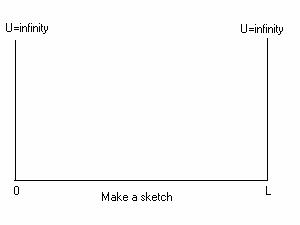
L ? (b) (3 points) Sketch the function (c) (3 points) What is the
probability of finding the particle between x = 0 and x = L/6. (e) (3 points) What is the
probability of finding the particle between x = 0 and x = 2L/6 ? (f) (3 points) What is the momentum of the particle? If you want to use the mass for the
calculation. Assume the particle is an electron of mass m = 9.11x10⁻³¹ kg.
------------------------------------------------------------------------------------------------------- 4. ( 22 POINTS) A particle is confined within a box
with perfectly rigid wall at x = 0 and x = L. Although the magnitude of the
instantaneous force exerted on the ball infinite and the time over which it
acts is zero, the impulse (that involves a product of force and time) is both
finite and quantized. In Chapter 8 we equated impulse to the change in momentum. ------------------------------------------------------------------------------------------------------- 5. (22) A harmonic oscillator consists of a 0.020 kg mass on
a spring. Its frequency is 1.50 Hz and the mass has a speed of 0.360 m/s as
it passes through the equilibrium position x = 0. ------------------------------------------------------------------------------------------------------- 6. ( 22 POINTS) In section
40.1 it was shown that for the ground level of a harmonic oscillator , |
 .
. 



 ,
where L is the well width.
,
where L is the well width.  .
. 