|
Quiz 2 |
||
2.

|
||
|
6.
(a)

 (b) The total flux through the cube must be zero; any flux entering the cube must also leave it, since the field is uniform. Our calculation gives the result; the sum of the fluxes calculated in part (a)is zero. |
||
|
4. (a)  (b) In the
calculation in part (a) the radius r
of the cylinder divided out, so the flux remains the same,
(c)
|
||
|
8. (a)
(b)
(c)
(d)
(e)
|
||
|
20
(a) For points outside a
uniform spherical charge distribution, all the charge can be considered
to be concentrated at the center of the sphere. The field outside the
sphere is thus inversely proportional to the square of the distance from
the center. In this case,
(b) For points outside a long
cylindrically symmetrical charge distribution, the field is identical to
that of a long line of charge:
(c) The field of an infinite
sheet of charge is
|
||
|
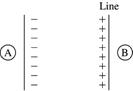
38. The fields can cancel only in the regions A and B shown in Figure.38
below, because only in these two regions are the two fields in opposite
directions.
The fields cancel 16 cm from the line in regions A
and B. The result is independent of the distance between the line and the sheet. The electric field of an infinite sheet of charge is uniform, independent of the distance from the sheet.
|
||
|
54. (a) Only at  is
is
 for the uniformly charged
sphere.
for the uniformly charged
sphere.(b) At points inside the sphere,  The field is radially
outward.
The field is radially
outward.
 The minus sign denotes that
 is radially inward. For
simple harmonic motion,
is radially inward. For
simple harmonic motion,
 where
where

 so
so
 and
and

(c) If
(d) If
|
||
|
30. (a) At a distance of 0.1 mm
from the center, the sheet appears “infinite,” so
(b) At a distance of 100 m
from the center, the sheet looks like a point, so:
(c) There would be no
difference if the sheet was a conductor. The charge would automatically
spread out evenly over both faces, giving it half the charge density on
either face as the insulator but the same electric field. Far away, they
both look like points with the same charge. |
||
|
44. (a) For
For
For
For
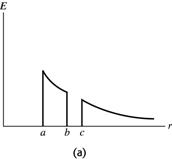
(b) The graph of E versus r is sketched in
Figure 44a. (c) Since the Gaussian sphere
of radius r, for
(d) Since the hollow sphere
has no net charge and has charge
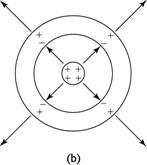
(e) The field lines are
sketched in Figure 44b. Where the field is nonzero, it is radially
outward. Evaluate: The
net charge on the inner solid conducting sphere is on the surface of
that sphere. The presence of the hollow sphere does not affect the
electric field in the region
|
||
|
32. (a) At
(b)

 |
||
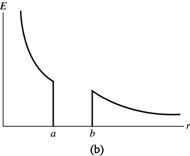
46.: (a)
For

 radially outward, since the
charge enclosed is Q, the
charge of the point charge. For
radially outward, since the
charge enclosed is Q, the
charge of the point charge. For

 since these points are
within the conducting material. For
since these points are
within the conducting material. For

 radially inward, since the
total enclosed charge is
radially inward, since the
total enclosed charge is

(b) Since a Gaussian surface
with radius r, for
(c) Since the net charge on
the shell is
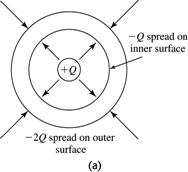
(d) The field lines and the
locations of the charges are sketched in Figure 46a. (e) The graph of E versus r is sketched in Figure 46b.
For
|
||
|
16.
: (a)
Solving Gauss’s law for q,
putting in the numbers, and recalling that q
is negative, gives
(b) Use the definition of
electric flux to find the electric field. The area to use is the surface
area of Mars.
(c) The surface charge density
on Mars is therefore
|