| READ ALL EXAMPLES ! SOME PROBLEMS ARE JUST LIKE AN EXAMPLE. |
|
Quiz 3 |
| * DISCUSSIONS PROVIDED either in class or on the web /** EVEN ANSWERS PROVIDED |
| DISCUSSIONS |
|
4. See example 1. We know the potential V at a distance r from a
single point charge is k*q/r,. When another point charge Q
placed at that location, the potential energy created is U = Q*V =
KQ*q/r. Note: Change in U = -W, where W is the work by the
field required to bring Q from infinity to a distance r from charge
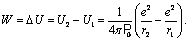
q. We want to compute the work W(a to b) done by the field when the distance between Q and q is changed from ra to rb. W(a to b) = -change in U. Now, change in U = k*Q*q/rb - k*Q*q/ra. Thus: W(a to b) = -change in U = k*Q*q/ra - k*Q*q/rb . Since the second radius ( at b) is smaller, the work by field W(a to b) < 0. Note: In moving the charge from a to b, the work Wyou you do is -W(a to b). Thus Wyou > 0. Note work you do = change in U. (b) Use conservation of energy (Ch. 7); KE means kinetic energy, U means potential energy, point 1 is when the two charges are close together, and point 2 is when they have moved back to the original distance : KE1 + U1 = KE2 + U2. Assume KE1 = 0 since they start from rest. Thus KE2 = U1 - U2 = where U1 is the potential energy when the protons are 3.00 x10⁻¹⁵ m apart and U2 is when they are 2.00x10⁻¹⁰ m apart. Thus KE2 > 0. Below is another way of seeing the problem: Identify: The work required is the change in electrical potential energy. The protons gain speed after being released because their potential energy is converted into kinetic energy. (a) Set Up: Using the
potential energy of a pair of point charges relative to infinity,
Execute: Factoring out the e2 and substituting numbers gives
(b) Set Up: The
protons have equal momentum, and since they have equal masses, they will
have equal speeds and hence equal kinetic energy.
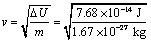
Execute: Solving for v
gives
Evaluate: The potential energy may seem small (compared to macroscopic energies), but it is enough to give each proton a speed of nearly 7 million m/s. |
|
5. (a) KEi + Ui = KEf + Uf. KEi = initial kinetic energy of charge 1, the only charge that's moving in the problem. Ui = k*q1*q2/r i . KEf = final KE of charge 1. Uf = k*q1*q2/rf . Find KEf and the final speed of charge 1. (b) Use the initial kinetic and potential energy given in the problem at separation distance 0.800 m. KEi + Ui = KEf + Uf. In this case KEf = 0 for charge 1. Find Uf and rf where charge 1 comes to rest. |
|
16. . Use work by field = -change in U . Now, change in U = q*change in V Change in V = -E*(6.00 m) . Thus, work by field = -change in U = -change in V = + E*(6.00 m). The work by field is positive as you would expect for motion of a positive charge in the direction of the electric field. (a) KEi + Ui = KEf + Uf. Thus change in U = KEi - KEf and thus work by field = -change in U = KEf - KEi, where the initial kinetic energy is zero and the final KE is given. (b) E*(6.00 m) = -change in U. Below is another way of seeing the problem: Identify: The work-energy theorem says
Set Up: Point a
is the starting and point b
is the ending point. Since the field is uniform,
Execute: (a)
(b)
(c)
Evaluate: A positive charge gains kinetic energy
when it moves to lower potential;
|
|
30. Lets talk about where V = 0 first: (a) (Q)----------------(2Q) Let the charge Q be to the left of charge 2Q an indicated in the above schematic where the separation distance is d. Since both charge are positive, do think there is a place where V = zero? I think not ! (b) (-Q)----------------(2Q) Let the charge -Q be to the left of charge 2Q an indicated in the above schematic where the separation distance is d. Certainly there is a point between the two charge where V = 0. Use: V = 0 = k(-Q)/d' + k(2Q)/(d - d'). Solve for d', the distance from the negative charge. We assume d' is positive; if d' is negative there is no solution between the charges. Now look to the left of -Q and to the right of 2Q: Left of -Q: Let d' be the distance from the negative charge. V = 0 = k(-Q)/d' + k(2Q)/(d + d') , where d' is the distance from negative charge. Solve for d'. We assume d' is positive; if d' is negative there is no solution to the left of negative charge. Right of 2Q: Let d' be the distance from the positive charge. V = 0 = k(-Q)/(d' +d) + k(2Q)/d' . Solve for d'. We assume d' is positive; if d' is negative there is no solution to the right of positive charge. Now let's talk about the electric field magnitude E and where it could be zero on the line drawn between the charges. a) (Q)----------------(2Q) Let the charge Q be to the left of charge 2Q an indicated in the above schematic where the separation distance is d. Since both charges are positive, do think there is a place to the right of left of Q or the right of 2Q where E = zero? I think not ! Now look at a point between the charges. E = 0 = kQ/d'2 - k*(2Q)/(d - d')2. , where d' is the distance from charge Q. Find d' by turning this relation into into a quadratic equation and finding d' . We assume d' is positive; choose positive root.. (b) (-Q)----------------(2Q) Since charges are opposite in sign are positive, do think there is a place between there charges where E = zero? I think not ! Now look to the left of -Q and to the right of 2Q: Left of -Q: Let d' be the distance from the negative charge. E = 0 = k(-Q)/d'2 + k(2Q)/(d + d')2 , where d' is the distance from negative charge. Solve for d'. We assume d' is positive; if d' is negative there is no solution to the left of negative charge. Right of 2Q: Let d' be the distance from the positive charge. E = 0 = k(-Q)/(d' +d)2 + k(2Q)/d' 2. Solve for d'. We assume d' is positive; if d' is negative there is no solution to the right of positive charge. (c) Are both E and V zero at the same places? Explain. Below is another way of seeing the problem: Identify: For a point charge,
Set Up:
Execute: (a)
(b) V can be zero in 2 places, A
and B, as shown in Figure 23.30b. Point A is a distance x from
The two electric fields are in opposite directions to the
left of
Evaluate: (d) E
and V
are not zero at the same places.
Figure 23.30
|
|
14. work by field = -change in U. Assume identical charges q are at the upper right and lower left of the square. Let us move the negative charge -qo from the upper left to the lower right corner. At upper left: U = -2k* qo*q /a. Find the U at the lower right and prove the change in U = 0; thus W = -change in U = 0. Below is another way of seeing the problem: Identify: For a point charge,
Set Up:
Execute: (a)
(b) V can be zero in 2 places, A
and B, as shown in Figure 23.30b. Point A is a distance x from
The two electric fields are in opposite directions to the
left of
Evaluate: (d) E
and V
are not zero at the same places.
Figure 23.30 |
|
18. Here is a schematic of the arrangement of the two stationary,
positive point charges: (Q1)----------------(Q2) The two charges above are separated by distance d. The electron
starts at the center and is more attracted to the charge on the right
end than the charge on the left end since we assume the right charge Q2
= |+3.00 nC (nano -coulomb); the electron moves rightward.
Identify: Apply
Set Up: Let
Execute:
Setting
Evaluate:
|
| 19. Use V = kq/r and solve for r in each case. |
|
43. (a) See example 23. 8. There is no charge inside the shell just
like a solid, spherical conductor. (b) Check back later. |
|
49. (b) and 61 ((b), are like two birds of the same feather. We
derived 61 (b) in class; let me take the opportunity to set
up the derivation of of 49 (b)---leaving certain steps for you to
derive E using Gauss's Law as we discussed in
class. We will discuss Part (a) of both problems in greater
detail in class-- there are two ways---integration or the the
book's recommendation of superposition. 49 (b) : First of all you need to prove, using Gauss's Law, the electric field magnitude E (for ra < r < rb ) = kq/r2 . Then you must evaluate the following integral: Vb - Va = -integral of Edr between a and b. In other words, integrate - kqdr/r2 between a and b. Clearly you will obtain the negative of the formula Vab shown in the problem on page 809. |
|
35. (a) Use the resultant formula of # 61(b): Vab = 2*k*lambda*ln
(b/a) where b = 2.50 cm and a = 1.00 cm. Set
2*k*lambda*ln (b/a) = 575 (V). Find lambda. (b) Redo with b = 3.30 cm and a = 1.00 cm and the lambda from the previous part. Your result should be greater than 575 (V). (c) Note that you are setting a = b = 3.50 cm, independent of the distance between the probes which have the same value of r. What is ln 1? |
|
60. Below is another way of seeing the problem:
Identify: Apply
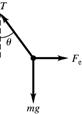
Set Up: The free-body diagram for the sphere is given in Figure 23.56. Execute:
Evaluate:
Figure 23.60 |
| MORE DISCUSSIONS LATER on #38 and #46 as well as the other parts of #49 and 61 !! |