|
Quiz 2 |
| * DISCUSSIONS PROVIDED/** EVEN ANSWERS PROVIDED |
| DISCUSSIONS |
|
2. THE DIRECTION BETWEEN THE NORMAL LINE , ASSUMED TO POINT
UPWARD , AND THE ELECTRIC FIELD IS 70 DEGREES. SEE FIG.
22.6 Below is another way of seeing the problem: The field is uniform and the surface is flat, so use
Set Up:
Execute:
 The flux in this problem is
much less than this because only the component of
The flux in this problem is
much less than this because only the component of
 perpendicular to the surface contributes to the
|
|
4. ASSUME THE NORMAL LINE ON EACH FACE POINTS OUTWARD
FROM WITHIN THE CLOSED CUBE. First of all, the electric field points
along the x-z plane which makes the angle with the normal
lines on side 1 and side 3 90 degrees-- there is no flux
through those sides . Flux only possibly goes through sides 2, 5, 4 and
6 ---the remaining 4 sides since two are removed from the list.
Let's look at each side Use similar logic to evaluate the flux through sides 6 and
5, where only the x-component of the field contributes. Hint
~ the
flux through side 6 is ZERO. Use
Eq.(22.3) to calculate the flux for each surface. Use Eq.(22.8) to
calculate the total enclosed charge. Set Up:
Execute:
(b)Total flux:
Evaluate: Flux is positive when
|
|
5. This problem is potentially tricky but not necessarily so if you
take care. Let the hemisphere have its axis along the z axis and
be concave down i.e. the hump points upward along z . Let r be the
magnitude of the radial vector from the origin to any point on the
hemisphere. Go here http://cnx.org/content/m13600/latest/
and scroll down to the section on spherical coordinates to a nice
model of the problem at hand. Let the electric field point in the
positive z direction. Think about a differential surface that is a
special circular strip. The radius is*r*sin phi so the
circumference is 2*pi*r* sin phi, where phi is the angle the radial vector makes with the z axis , also called the polar angle. The differential thickness of the strip is r*d phi. Thus the differential area is 2*pi*r2*sin phi * d phi, where the range of integration will be from phi = 0 to phi = pi/2 (90 degrees) SINCE WE HAVE A HEMISPHERE. The electric field vector at each point on the surface makes an angle phi with the differential section of surface . Note we have integrated around the full range --2*pi--of the azimuthal angle theta---explained at http://cnx.org/content/m13600/latest/ --- which is why the radius of the strip was designated 2*pi*r sin phi, where the 2*pi reflects the procedure around a full (azimuthal) circle. Thus E*dA*cos phi = E*2*pi*r2*sin phi*cos phi * d phi. Integrate this expression over phi between 0 and pi/2. USE TRIG IDENTITY---sin phi * cos phi = (1/2)*sin 2 phi. Note you can get the same result by realizing the flux through the hemispherical surface is the same---IN MAGNITUDE ONLY---as the flux through the flat circular surface of radius r bounded by the circular hemisphere bottom edge. In this case the flux is E*(area of the flat circle of radius r) |
| 7. See example 22.6, reviewed in class. Note the flux through the "curvy " side, which has area proportional to r, is independent of radius r using the derived formula for the electric field magnitude which varies as 1/r. So the two powers of r cancel. |
|
8. In each case the integral of E*dA* cos theta = charge
enclosed/epsilono Below is another way of seeing the problem: Apply Gauss’s law to each surface. Set Up:
Execute: (a)
(b)
(c)
(d)
(e)
Evaluate: (f)
All that matters for Gauss’s law is the total amount of charge
enclosed by the surface, not its distribution within the surface.
|
|
22. (a) See example 22.5 and figure figure 22.17 for any general
conductor. The charged spherical conductor's radius is R = 0.100
m, so any values of r < 0.100 m will produce zero electric field. (b) See example 22.6 and figure 22.17 for any general conductor, including a long thin line as in this part. The charged linear conductor's radius is R = 0.100 m, so any values of r < 0.100 m will produce zero electric field. (c) The electric field is constant on a given side of the sheet. See example 22.7. Below is another way of seeing the problem: Apply the results of Examples 22.5, 22.6 and 22.7. Set Up: Gauss’s law can be used to show that the field outside a long conducting cylinder is the same as for a line of charge along the axis of the cylinder. Execute: (a) For points outside a uniform spherical charge distribution, all the charge can be considered to be concentrated at the center of the sphere. The field outside the sphere is thus inversely proportional to the square of the distance from the center. In this case,
(b) For points
outside a long cylindrically symmetrical charge distribution, the field
is identical to that of a long line of charge:
(c) The field of
an infinite sheet of charge is
|
|
36. Let the charged long line and the plane of charge both be
perpendicular to the page you are looking at. Let the plane be be
horizontal on your page. Examine any point directly
vertically above the line of charge. In this case, the
electric field due to the line of charge points up and the field from
the plane points down. Find the distance above the line where the two
fields cancel using formulae for the field magnitude E in example 22.6
and example 22.7 Below is another way of seeing the problem: Identify: The
Set Up: The fields can cancel only in the regions A and B shown in Figure 22.36, because only in these two regions are the two fields in opposite directions. Execute:
The fields cancel 16 cm from the line in regions A and B. Evaluate: The result is independent of the distance between the line and the sheet. The electric field of an infinite sheet of charge is uniform, independent of the distance from the sheet.
Figure 22.36
|
| 25. See example 22.9. |
|
52. More discussions on this will follow , but the
starting point of this historical problem is example 22.9.
Find the electric field as a function of r inside the NON-conducting sphere
AND then find the force on an electron inside the sphere. That
force should always point to the center of the sphere and will support simple
harmonic oscillations for small displacements of the electron from the equilibrium
positron at center. Below is another way of seeing the problem: Identify: Example 22.9 gives the expression
for the electric field both inside and outside a uniformly charged
sphere. Use
Set
Up: The sphere has charge
Execute: (a)
Only at
(b)
At points inside the sphere,
(c)
If
(d)
If
Evaluate: As long as the initial displacement
is less than R the frequency
of the motion is independent of the initial displacement.
|
|
23. See example 22.5 and figures 22.23 (a), (b) and (c),
especially (b) and (c). See also example 22.11 and figure 22.28 for
extra reinforcement. (a) Before you inserted the point charge in the cavity, the problem looked like fig. 22.23 (b); after you insert the charge inside the cavity, we have fig. 22.23 (c). READ EXAMPLE 22.11 IN DETAIL. Find the charge on the outer surface as in example 22.11; to get charge density, compute density = (outer surface charge)/(outer surface area), where the surface area of any sphere is 4*pi*r2. The outer radius is given. (b) The electric field on the outside surface of the conductor has magnitude E given by equation 22.10; thus you need the charge density on the outer surface given in part (a). Again, that density = (outside surface charge)/(outer surface area) (c) The flux = (charge enclosed)/epsilon. Charge enclosed = -0.500x10⁻⁶ C. |
|
28. (a) At this location the sheet appears to be infinite and you
would use equation E = (surface density)/(2*epsilon) as in example
22.7. (b) At this distance the sheet would behave like a point charge; thus E = k*Q/D2, where D = 100 m and Q = (charge density)*(sheet area) . Below is another way of seeing the problem: Identify: Close to a finite sheet the field is the same as for an infinite sheet. Very far from a finite sheet the field is that of a point charge. Set Up: For
an infinite sheet,
Execute: (a) At a distance of 0.1 mm from the center, the sheet appears “infinite,” so
(b) At a distance of 100 m from the center, the sheet looks like a point, so:
(c) There would be no difference if the sheet was a conductor. The charge would automatically spread out evenly over both faces, giving it half the charge density on either face as the insulator but the same electric field. Far away, they both look like points with the same charge. Evaluate: The
sheet can be treated as infinite at points where the distance to the
sheet is much less than the distance to the edge of the sheet. The sheet
can be treated as a point charge at points for which the distance to the
sheet is much greater than the dimensions of the sheet.
|
|
42. See figures 22.23 (a), (b) and (c), especially (b) and (c).
READ EXAMPLE 22.11 IN DETAIL. You can use Gauss's Law to explain
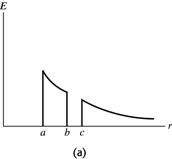
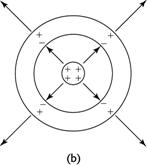
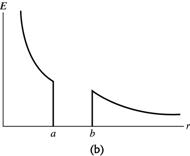
part (a). (a) Clearly E = 0 for b < r < c since this double inequality (i.e. range) refers to points within the hollow conductor . For r < a, we also have E = 0. For a < r < b, we have the electric field due to a point charge of magnitude | q|. i.e. , magnitude E = k*q/r2. For r > c, we have for the flux E*(4 *pi*r2) = (q enclosed)/epsilon, where r > c and q enclosed = q. (b) The graph of E is described in the previous part. (c) See example 22.11 and treat the conductor of radius a within the cavity as a point charge when you draw a Gaussian spherical surface of radius r concentric with the system with a < r < b. (d) See example 22.11. (e) The field lines will be radial and disappear inside the conductors. They begin on the surface of the small conductor of radius a inside the cavity. They are radial inside the space a < r < b and disappear for b < r < c, terminating on the inner surface of the hollow conductor, and reappearing radially when c < r outside the hollow spherical conductor . Below is another way of seeing the problem: Identify: Apply Gauss’s law. Set Up: Use a Gaussian surface that is a sphere of radius r and that is concentric with the conducting spheres. Execute: (a)
For
For
For
For
(b) The graph of E versus r is sketched in Figure 22.42a. (c) Since the
Gaussian sphere of radius r,
for
(d) Since the
hollow sphere has no net charge and has charge
(e) The field lines are sketched in Figure 22.42b. Where the field is nonzero, it is radially outward. Evaluate: The
net charge on the inner solid conducting sphere is on the surface of
that sphere. The presence of the hollow sphere does not affect the
electric field in the region
Figure 22.42
|
|
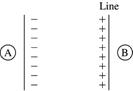
27. Assume negligible charge on the outside surfaces of the plates.
We use S2 and S3 to find the field outside the plates and since no
charge is enclosed within these Gaussian surfaces, the field outside
must be ZERO.
Now with regard to S4, we have a double argument which I'll
explain now: You can use a second argument to get the electric field of magnitude
E between the plates. Assume the oppositely charged inner surfaces can
be represented as infinite charged parallel non-conducting sheets.
The net field would be the sum of the field of the two sheets E = |
|
30. See example 21.13 for help on using superposition to find
the net field by adding the individual fields for each sheet. This
problem is a little more complicated because we have 4
sheets but same principles apply. Below is another way of seeing the problem: Set Up: The
electric field of a large sheet of charge is
Execute: (a)
At
(b)
(c)
Evaluate: The
field at C is not zero. The
pieces of plastic are not conductors. |
| 43. The shell surrounds the concentric solid conductor. See #42 DISCUSSIONS above. |
|
44. See example 22.5 and figures 22.23 (a), (b) and (c),
especially (b) and (c). See also example 22.11 and figure 22.28 for
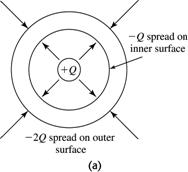
extra reinforcement. ALSO SEE #23 DISCUSSION. Below is another way of seeing the problem: Identify: Apply Gauss’s law and conservation of charge. Set Up: Use a Gaussian surface that is a sphere of radius r and that has the point charge at its center. Execute: (a)
For
(b)
Since a Gaussian surface with radius r,
for
(c) Since the
net charge on the shell is
(d) The field lines and the locations of the charges are sketched in Figure 22.44a. (e) The graph of E versus r is sketched in Figure 22.44b.
Figure 22.44 Evaluate:
For
|
|
18. FLUX = E*(4 *pi*r2) = |q enclosed|/epsilon.
Note: r = Mars' radius, which if known, allows you
to compute E. Below is another way of seeing the problem: Identify: According to Exercise 21.32, the Earth’s electric field points towards its center. Since Mars’s electric field is similar to that of Earth, we assume it points toward the center of Mars. Therefore the charge on Mars must be negative. We use Gauss’s law to relate the electric flux to the charge causing it. Set Up: Gauss’s
law is
Execute: (a)
Solving Gauss’s law for q,
putting in the numbers, and recalling that q
is negative, gives
(b) Use the
definition of electric flux to find the electric field. The area to use
is the surface area of Mars.
(c) The surface
charge density on Mars is therefore
Evaluate: Even
though the charge on Mars is very large, it is spread over a large area,
giving a small surface charge density.
|
| CHECK BACK FOR MORE DISCUSSIONS |