|
QUIZ 5, CHAPTER 24 PROBLEMS : CH 24:
12(I), 14, 17, 18, 26, 30, 31, 32, 35, 39*, 43(I)*, 44*, 46*, 50*,
51*, 63(III), 70*, 73*, 76, 80*, 91* Problems 50, 51, and 63 (along with
example 24-11) provide a
triangle of problems exploring energy in parallel plate
capacitors, including the presence or absence of dielectrics
in the space between plates. |
|
. Simulation: Click here for the motion of an electron in a uniform electric field. |
| Ch. 24. |
| 12. Derive the capacitance by integrating between the two surfaces to get the voltage change used in the definition . Then evaluate your formula at the values specified. |
| 14. E*2*pi*r*L = lambdaNET*L/epsilon. Now, lambdaNET is the net charge density (C/m). Inside the inner conductor, the net density is zero, since no charge is enclosed; the sign of the outer surface charge density is oppose that of the inner surface so the net density out side is zero. You solution should convey these points though you may express them in your unique way; there is often more than one way to formulate a correct solution. |
| 17. C = Q/V = Q/E*d |
| 18. C = Q/V = Q/[E*(d - L)] . Compare this expression with #17. The integral of E*dl from one capacitor plate to the other is reduced because the electric field is zero for a distance L , the metal sheet thickness. Remember that Q = (density)*A and E = density/epsilon as you proceed with the derivation. |
| 26. You are making two
capacitors from the three plates. Each capacitor has
two plates by definition. The top plate is one of the plates
of the first capacitor and the bottom plate is one of the
plates of the second capacitor. These two plates are at the same
voltage V. The other plate of each capacitor is the
middle plate; in other words the middle plate is shared by
the two capacitors. That middle plate is at zero
voltage. Since the top plate and bottom plate are at the same voltage V, the voltage difference across each capacitor is the same and is equal to V- 0 = V. Are the capacitors in series or in parallel? |
| 30. C1 and C2 are in series so the charge on C1
is also 12.4x10⁻⁶ C. The total voltage across
both these identical two capacitors is , Q1/C1 + Q2/ C2 = 2*Q1/C1 = 2* 12.4/16.0 = 1.55 (V). This is the voltage V3 across C3, thus you can get Q3 = C3*V3. Finally, you should compute the equivalent capacitor combination of C1, C2 and C3. This equivalent is C= C3 + (1/C1 +1/C2)-1 = 16µF + (1/16 + 1/16)-1µF = 16µF + 8µF = 24 µF . The charge on this equivalent capacitor is Q = C*V = 24µF *1.55 (V) = 37.2 µF . Since this equivalent capacitor is in series with C4, then what is Q4? Finally, find the total voltage difference between points a and b. |
| 31. If C2 is fully charged, the charge will be Q2
= C2*Vo when the switch is connected downward. After the switch is
connected upward, some of the charge leaves C2 and distributes
onto C1. There are two equations: (A) C2*Vo = Q1' + Q2', where Q1' and Q2' are the final charges on C1 and C2. (B) The second equation arises from net zero voltage drop around the loop created when you switch upward: Q1'/C1 = Q2'/C2. Here are the equations: (A) C2*Vo = Q1' + Q2' (B) Q1'/C1 = Q2'/C2 Solve (A) and (B) for Q1' and Q2'. Your answers will be in terms of symbols C2, C1 and Vo. |
| 32. Again you answers will be in terms of C1, C2
, C3, C4 and V. (a) You should be able to see that 1/CEQ = 1/(C1 + C2) + 1/(C3 + C4). Find CEQ by evaluating the reciprocal of the previous expression. (b) Note: You should be able to see that Q/(C1 + C2) + Q/(C3 + C4) = V, where Q = Q1 + Q2 = Q3 + Q4. Solve for Q in terms of C1, C2, C3, C4 and V. You can now solve for Q1 and Q2 using Q1 + Q2 = Q and Q1/C1 = Q2/C2. You can now solve for Q3 and Q4 using Q3 + Q4 = Q and Q3/C3 = Q4/C4. |
| 35. Clearly, (A) Q2/C2 = Q1/C2 and (B) Q3/C3 = Qx/Cx. Also C2 and C3 are in series; likewise, C1 and Cx are in series. Thus, (C) Q2 = Q3 and (D) Q1 = Qx. Solve this system of equations (A), (B), (C) and (D) to get Cx in terms of C1 , C2 and C3. |
| 39. Differential capacitance dC = dA'*eo/x.
This is the differential form of equation 24-2. dA' =
L*dy, where L is the width of the square plate.
Now, x = d + y*tan (theta), where theta is the given constant
angle.
Integrate dC= L*dy/(d + y*tan theta) from zero to L. Note that L2 = A = plate area, so that L can be written as the square root of A. |
| 43. U = Q2/2C, where C can be gotten from the given d and A. |
| 44. U = Q2/2C, where C = A*eo/d.
Thus, U = Q2*d/(2A*eo) We see the
potential energy is proportional to the separation distance d,
assuming Q is held constant.
(a) Compute the ratio (U at distance d)/(U at distance
3d). |
| 46. (a) U = Q2/2C, where C = C1 + C2 and Q = (C1 + C2)*(28 volts) (b) U = Q2/2C, where C = C1*C2/(C1 + C2) and Q = C*(18 volts). (c) See parts (a) and (b) for the charges requested.
|
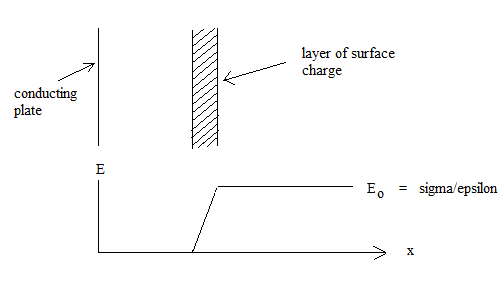
| 50. (a) Now were are getting into some interesting physics. See problem 44. We assume the work you do is the change in potential energy as we did before. We know the plates attract each other. Let the plates be as shown in fig 24-4. Let the positive x direction be rightward on the page. The force on the right plate points in the negative x direction; thus, Fx <0. This would be equal in magnitude to the force you would have to exert to keep the plates from moving toward other. Now, we know from Physics 4A, that if the force is conservative, the force component in any direction equals the negative of the partial derivative of the potential energy with respect to that direction. In this case we expect the force to be one dimensional, along x, so U would be only a function of x. U(x) = Q2/2C and Fx = -dU/dx, where Fx is the force on the right plate due to the left plate. From problem 44, U = Q2*x/(2A*eo), where x is the distance between the left and right plates which is in this case identical to the coordinate of the right plate. We assume the left plate is at x = 0. Differentiate this with respect to x to get the requested result written in coordinate form; your answer will be negative yet consistent physically with the book's expression on page 647, which is the magnitude of this "hint-based" expression. (b) The above part should give you a sound understanding of the process; check back later here for more discussions. But basically it's this: To get the correct answer using the force method, you write dF = dq*E where dF is the force on a differential slice of the plate under the influence of the electric field due to the other plate alone, modelled as a this sheet of charge. Here E = Q/(2Aeo).* The factor of 2 persists during the integration for the entire force on the plate. *The electric field between the two plates can be thought of as the superposition of two fields, from a positive and a negative sheet of charge. Each contributes the field magnitude E = (density)/2eo, Thus Enet = (density)/2eo ,+ (density)/2eo, = (density)/eo, In this interpretation density = Q/A, where A is the
area of the plate face. Since we are only considering electric
field due to the other plate alone, the effective net field
is (density)/2eo ANOTHER APPROACH ALLUDED TO IN CLASS: In this approach, we assume that the surface charges
experience a force due to the electric field at
the charges, not the electric field between the
plates. As you can see in the above diagram, the
electric field does not die off suddenly but decreases from Eo
at the surface to zero at the left edge of the charge layer
and remains zero beyond that edge inside the
conductor. |
| 51. (a) This integration is a classic one, so I thought I'd give you this problem, the same one we solved back in the day as a undergraduate . Consider thin spherical shells of thickness dr and area 4*pi*r2, where pi = 3.14 evaluated at maximum computational accuracy possible. These shells have differential volume dV = 4*pi*r2*dr . We use equation 24-6 along with 21-4a and the expression for the differential energy = uE* dV = uE*dV = uE*4*pi*r2*dr . = (1/2)*eo*(k2Q2/r4)*4*pi*r2*dr = (1/2)*eo*(k2Q2/r2)*4*pi*dr . Integrate this from ro to infinity. (b) and (c): more discussions later on these more advanced topics that are more appropriate for the homework than the final exam. But the point of part (c) is this: The work you do to pull the charges together into a spherical shape equals the electric field energy in the entire space around the conducting sphere. This leads to conceptual difficulties looking at the expression sought on page 647. As you can see, as ro goes to zero, the electrostatic field energy does to infinity. That suggests the point charge model of the electron (assumed to have zero radius) is unattainable since the field energy would go to infinity, a physical impossibility ---it is impossible to assemble a finite amount of charge Q into a single point classically. Obviously the explanation of the electron requires higher level modeling (invoking non-classical quantum mechanics) beyond our scope; but even there, in that intellectual stratosphere, the problem's solution continues to elude the hardest working physicists.. |
| 63. This a a powerful problem, best
illustrated via comparison and contrast with the situation
of inserting a dielectric slab while the charge Q is held constant
as in example 24-11 where the plates with charge magnitude Q are
disconnected from the battery. In this problem we are
inserting the dielectric while the voltage between the plates,
connected to a battery, is held constant. Let us write down the two situations: I. Problem 63: Constant voltage while dielectric is inserted. : U = (1/2)*C*V2, where V = V+ - V - = voltage difference between the plates. Note: V = constant II. Example 24-11: Constant charge Q on the plates while dielectric is inserted : U = (1/2)*Q2 /C, where Q is the constant charge .Note: The charge increases on the section of the plates next to the dielectric, whereas on the section of the plates not next to the dielectric the charge remains constant until the dielectric arrives. The battery supplies this extra charge so the insertion of the dielectric requires energy expenditure from the battery. In both cases you can say that the positive x direction is left as in Fig. 24-32. We would want to find Fx = -dU/dx, a formula from Chapter 8 which deals with conservative forces derived from the potential energy by taking the negative of the derivative of U: Fx = -dU/dx. If Fx < 0, then the dielectric slab is repelled by the plates. If Fx > 0, then the dielectric slab is attracted to the plates. In both cases you will have to find the capacitance, which will be the same. The partly inserted slab creates two capacitors in parallel. CNET = Co + KCo, where Co = A*epsilon/d is the capacitance without a dielectric slab. CNET = Co + KCo = L*(L-x)*epsilon/d + K*L*x*epsilon/d = (L*epsilon/d)*[ (L-x) + K*x] . CNET is clearly a function of x. Substitute CNET into the expressions under I and II. Evaluate -dU/dx . If Fx <0, then the dielectric slab is repelled by the plates. If Fx > 0, then the dielectric slab is attracted to the plates. |
| 70. (a) See example 24-3. The capacitance of an isolated sphere of radius R is C= R/k. Note that numerically k = 9x10⁹ . Thus numerically C is on the order Rx10-10 F. If the radius R = 1 cm = 10 -2 m, then numerically C is on the order of 10 -12 , which is on the order of magnitude of a pF, defined to be 10 -12 F. (b) Forget the rule, just find C = R/k, where R = 1 m. Convert distances to meters. (c) When you walk on the rug, you acquire the charge Q as the result of charging by friction, whereby electrons are transferred from you to the rug. C = Q/V = R/k = Q/(E*d). Both E and d are given, the electric field magnitude and arc distance respectively. Find Q. Convert distances to meters. Note 1 kV = 1000 V. |
| 73. I use upper case K for the dielectric constant in contrast to the lower case k discussed in the previous problem. The voltage between the plates will go down; remember the net electric field is reduced because of the polarized "edge" charges in the paraffin dielectric : E = Eo/K, where K is the dielectric constant for paraffin--see Table 24-1 and my lecture discussion which was a rendition of section 24-6 (simplified version). The old voltage V = Eo*d, where d is the unknown distance between the plates, which you do not need to answer the question about the reduced voltage difference. But the expression helps. The new voltage difference would be (Eo /K)*d, which is the the old voltage reduced by a factor of K; thus whatever the old voltage was, you divide by K to get the new one after you insert paraffin between plates. |
| 76. (a) This is an answer in terms of
the radii symbols and the K symbol given. See example 24-2.
The only difference here is that the electric field will have a
factor of K in the denominator, since the electric field is
reduced because of the polarized "edge" charges in
the dielectric insulator surrounding the conducting sheath of
radius Ra; see the previous problem. E = Eo/K,
where K is a symbol for the dielectric constant. Thus the electric
field used in example will 2*k*(lambda)/(K*R). You will integrate
this just like example 24-2 and my lecture notes. (b) Evaluate with the specific values. I will provide a hint later; check back soon. |
| 80. (a) C = A*eo/d, where A and d are given. (b) C = Q/V, where V = 35,000,000 (V). Find Q. |
| 91. This problem is exactly the same as # 50.
Your work = change in potential energy. Differentially, dW = dU, where dW = your work, and dU is the differential change in potential energy. Now, dU = -dWField = -Fxdx, where Fx is the force of attraction discussed in #50. Fx = - Q2/A*eo . Substitute and integrate between x and 2x. |
| The following discussions, dealing with RC circuits, introduce Quiz 7, Chapter 26. The remaining Q7 problems will be posted soon. |
| 43. See example 26-14, dealing with turn signals. Both turn signals and windshield wipers involve repetitive motions based upon alternate charging and discharging. A typical turn signal flashes perhaps twice per second and a typical windshield wiper wipes once per second up or down. |
| 44. (a) RC = 24x10-6 seconds; find C given R. (b) Use equation 26-6a for the charge on the positive plate of the capacitor. Q = C*E(1 - e-t/RC), where E = 24.0 (V). The voltage across the resistor has magnitude I*R. To get I , differentiate the expression for Q: I = dQ/dt. You will get a decaying exponential of the form Io*e-t/RC. Note Io = E/R. Thus, I*R = E*e-t/RC , where E = 24.0 (V). Find the time it takes I*R to decrease from 24.0 (V) to 16.0 (V) |
| more discussions to come! |