|
Quiz 2 Chapter 21 problems: QUIZ 1,
CHAPTER 21: 46*, 47*, 48* (DIPOLE PRACTICE), 49*, 59*, 62*, 65*,
80*, 86*, 91* |
|
Below is a link to a discussion of Gauss's Law (Ch.22, Quiz 3 TBA)
presented by Richard P. Feynman. ( http://en.wikipedia.org/wiki/Richard_Feynman ). He shows there is no position of stable equilibrium in a configuration of charges in space. Atoms are stable only because the electrons are held in "orbits" according to Quantum Mechanics and have well defined energy states. The positive nucleus pulls the electrons in close but there is a spread in the possible locations of the electrons due to the Heisenberg Uncertainty Principle--if the electrons were precisely localized, there would be a large uncertainty in the electrons' momentum, resulting in some electrons with large enough momentum and energy escaping the electro-static grip of the nucleus. Since such escapes are not observed, the electrons must be "spread out" within "clouds." More practically, through Chapter 22 knowledge you can compute more easily fields using symmetry. For example you can find the field near a long line of charge faster than in Chapter 21 where computations are more tricky. In Ch. 21, the long line of charge calculation is done for you and is related to results for problems 46 and 47 below. http://www.scribd.com/doc/20697866/Vol-2-Ch-05-Application-of-Gauss-Law As Feynman above and our own textbook observe, one consequence
of Gauss's Law is the formula for the magnitude of the perpendicular
electric field on the surface of a charged conductor (in
equilibrium) : E= (charge density)/epsilon = (charge density)/eo
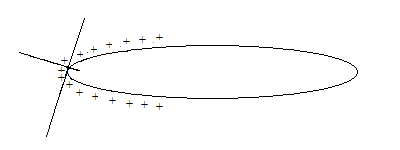
. If a conductor tapers to a sharp point, the charge density will be
very high in that region, resulting in a large electric field--large
enough to "pull" electrons from the chemical grip of the
surface, assuming the tip has excess negative charge on the
surface. The electrons move along the field lines through a
vacuumed space and strike a positive screen. Electrons recorded as having a
lower speed were pulled from conductor sections with strong chemical
binding and those higher speed from regions of low chemical binding.
From such information we get a map of the chemical surface structure
on the electron emitting, tapered conductor: http://en.wikipedia.org/wiki/Field_emission_microscopy
. |
|
Simulation: Click here for the motion of an electron in a uniform electric field. |
| 46. See the integral in example 21-11, just realize you don't integrate from -pi/2 to +pi/2, where pi = 3.14.... . Instead you will evaluate sin theta at different limits. Have a close look at figure 21-29. Suppose the angle was indeed the maximum angle, and thus the value of y was L/2. We see that sin theta = opposite/ hypotenuse = L/[2*(L2/4 + x2)1/2 ] . Substitute sin theta into the upper and lower limits of the integral at the bottom of page 573. |
| 47. This is easy if you look at the figure as a pyramid with four inclined sides converging on the observation point at height z. The electric field due to a given side makes an angle with the horizontal given by tan theta = z/ (L/2) = 2*z/L, where L is the square's length. This field has two components, horizontal and vertical. When you sum the fields from all 4 sides, the horizontal components cancel from symmetry. The 4 vertical components survive; the net vertical component is Ez = 4*E*sin theta. You can identify sine theta by looking at the figure. Hint: Compute the hypotenuse of a right triangle with sides z and L/2 . Note E is the electric field magnitude at a point in space a distance (L2/4 + z2)1/2 from a side. See problem 46. |
| 48. See the derivation on page 580. It's the same problem if you make the substitution L/2 = a and r = x. Same problem, different symbols. However you should understand the problem's essence not just be able to "reverse-engineer'" through clever substitutions. Also give the direction of the field. Does it point vertically up or vertically down the page? |
|
49. This is an easy problem if you realize from symmetry
the field must point horizontally along the x -axis in the negative
direction (left). The leftward differential field has
x-component dEx = -[k*Lambda*dL/R2]*
cos @, where angle @ ranges from -@o to + @o.
Note that dL = R*d@. Integrate -[k*Lambda*R*d@/R2]*
cos @ = -k*Lambda cos@ d@ /R between -@o to + @o . |
|
59. This problem is identical to the future lab dealing with an electron moving in a uniform electric field. Click here . The exit angle theta is given by tan theta = |Vy |/ |Vx|, where Vy and Vx will be covered in pre-lab discussions. |
| 62. See class references and section 21-11. The torque and potential energy are derived and discussed in detail using comparisons with simple harmonic motion of a mass attached to a spring. Use equations 21-9 and 21-10. |
| 65. (a) As discussed in class the condition for simple harmonic motion was angle @ being so small you could say sin @ = @ as a first order approximation. With the small angle approximation you write, I*d2@/dt2 = -p*E*@, where p is the electric dipole moment magnitude, I is the moment of inertia about the charges' midpoint and E is the electric field magnitude. (b) See class notes. |
| 80. Review equilibrium from Physics
4A. Consider for example the right sphere of charge Q/2 and
mass m = 0.0024 kg. There are three forces acting on the hanging mass: the tension force directed along the wire at 26 degrees with the vertical, the down ward gravitational force, and the electric force directed horizontally right. Break each force into horizontal and vertical components. Note the gravitational force, aka weight, points downward. Only the tension force of magnitude T has two non-zero components. For the x direction: T*sin26 = kQ2/(4d2 ), where d is the horizontal distance between the two charges. You can easily find distance d by inspection and trigonometry applied to the right triangle of hypotenuse.0.78 m The second equation is for the y-direction: T*cos26 = mg. Solve the above x and y-direction equations simultaneously for Q and T. |
| 86. This is an easy problem if you know the
centripetal force keeps the electron in orbit about
the wire's center. The centripetal force in this case is the
electric force directed toward the wire. That force has
magnitude e*E, where e and E are the electric charge and electric
field magnitudes, respectively. To find E, which is a
function of r, see example 22-6 or example 21-11, which give
similar results through different means. Note that in example
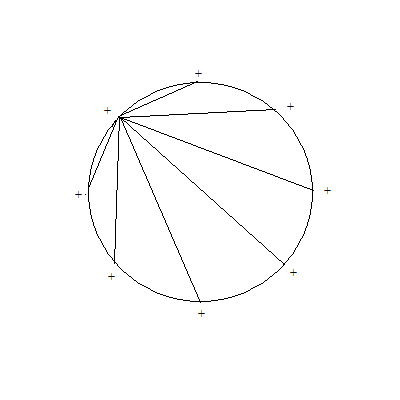
21-11, x = r and in example 22-6, R = r. Now, we know that mv2/r = e*E, where E is inversely proportional to r as shown in the above-mentioned examples. (a) See examples 22-6 and 21-11. (b) Use mv2/r = e*E. Is the value of r needed to solve this problem? Explain. |
| 91. This problem is similar to #80. The hanging
mass is in equilibrium. Now the question is whether the plane is
positive or negative. If the plane is negative, then the electric
force is down, in which case the tension would be more than
the weight in magnitude and 0 = T - Q*E - mg. If the plate
was positive, the electric force would be directed up, in which
case the tension would be less than the weight in magnitude
and 0 = T + Q*E - mg. You must make your choice by comparing
T with mg. Above, T is the tension force magnitude, Q is the charge, E is the electric field magnitude and mg is the weight. Mass m, charge Q and tension magnitude T are given. (a) Solve for E. (b) Solve for the charge density using example 22-7 or example 21-12 in the limit of infinite R (equation 21-7.). |