|
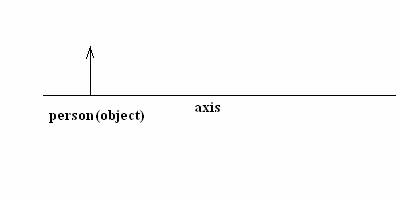
1. (53 points) The upright object shown below is to the
left of a converging lens with a focal length of 20 cm ( not shown).
The object produces a real image which is one half the size of the
object.
SOLUTIONS
Obviously the image is TO THE RIGHT OF THE OBJECT BECAUSE THE IMAGE
IS REAL
(a) 1/f = 1/do + 1/di where we need do AND di ! BUT magnification m = -1/2; remember
when the image is real the value of m is negative in the case of a thin
converging lens. Get ready for this concept on the final exam IN
COMPARISON to magnifying glass below, a converging lens producing a virtual
image behind (to the left of) the object !
Now, -1/2 = -di/do. Thus, solve for di = do/2. Thus 1/0.20 = 3/do so that
do = 0.60 m.
(b) m = -1/2 means
image is inverted.
(c) di
=
do/2 =
0.30 m via substitution in above equations.
-----------------------------------------------------------------------------------------------
(a) (30 points) How far from the lens
is the object?
(b) ( 3
points) Is the image upright or
inverted (upside down)? Explain.
(c) (13 points) How far from the lens is the image?
(d) (4 points) On the diagram above sketch the lens on the
right of the object. Draw the image by
ray tracing as we did in class. Ray trace by drawing two rays from the tip of
the arrow, one parallel to the axis and the other going though the center of
the lens. Label the object distance do and image distance di.
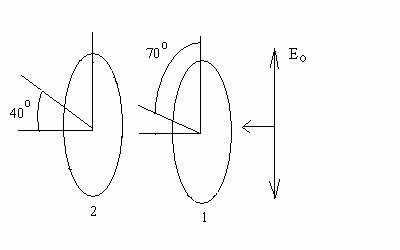
2.  (25 points) A beam of vertically polarized light with intensity
41 W/m2 is sent leftward through two polarizing sheets. The
vertically polarized wave is shown below moving toward Sheet 1. The polarizing direction of Sheet 1 makes an angle of 700
with the vertical. The polarizing direction of Sheet 2 makes an angle of 400 with the horizontal. (25 points) A beam of vertically polarized light with intensity
41 W/m2 is sent leftward through two polarizing sheets. The
vertically polarized wave is shown below moving toward Sheet 1. The polarizing direction of Sheet 1 makes an angle of 700
with the vertical. The polarizing direction of Sheet 2 makes an angle of 400 with the horizontal.
SOLUTIONS
The first polarizers' axes makes
a 70 degree angle with vertical and the second
polarizer makes angle 50 degrees with the vertical using basic
geometry/trig. Review your trig !!. Thus the polarizers make an angle of
20 degrees between each other, word is bond. Let Io
be the intensity of the light before going through the first
polarizer. Assume this light is polarized along a direction making
an angle 70 degrees with the first polarizer axis. The intensity
after passing through polarizer 1 is I1 = Io*cos2 70 . The intensity is reduced
again after transmitting through polarizer 2. Since
polarizer 2's axis makes a 20 degree angle with
polarizer 1's axis, we have
I2 = I1*cos2 20. That is: I2
= Io*cos270*cos2
20 = 4.2 W/m2 given initial intensity of
41 W/m2
.
----------------------------------------------------------------------------------------------------------------------------------
(a)
(12 points) What is the Intensity of the
light after it passes through Sheet 1 before
reaching Sheet
.
(b) (13 points) What is the Intensity of the light after
it passes through Sheet 2?
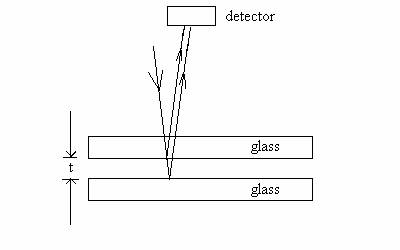
3. (38 points) Two parallel plates of glass are separated by an air gap
of thickness t. Light of wavelength 625
nm falls perpendicular to the plates.
SOLUTIONS
(a) 2*t = lambda/2---
note the role reversal switching the definition of constructive and destructive
interference. Thus, t = 156 nm.
(b) 2*t = lambda---
note the role reversal---giving t = 313 nm.
------------------------------------------------------------------------------------------------------------------------
(a) (19 points) What
minimum thickness t will
produce constructive interference at the detector?
(b) (19 points) What minimum
non zero thickness t will produce
destructive interference at the
detector?
4. (37 points) A magnifying glass is formed from a
single double convex
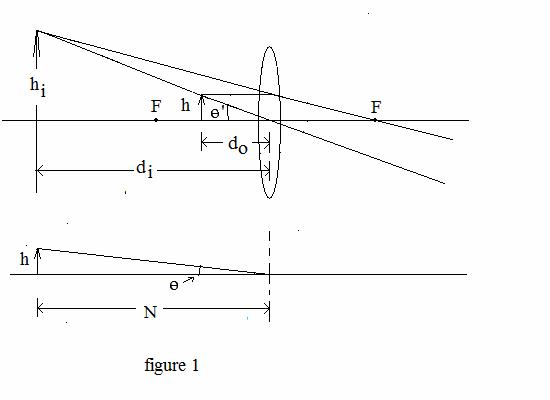
(converging) lens with a focal length of f = +12.0 cm . The lens, with focal points labeled by F, is shown in the schematic (figure 1) below. It could be the model for a Bart passenger’s reading
glasses while she scans the afternoon’s news headlines. The distance | di
| is the
distance between one of the lens’s and
the image of the news story of the Sharks victory she wants to read
about. The figure 1 below applies directly to part (a).
Note that N = near point distance
= 25 cm. A modified diagram would have to be drawn for part (b) in figure 2’s
space.
SOLUTIONS
(a) See figure 25.16. Note: di
= -N, where is the near point distance .
M = 1/f + 1 = 3.1
(b) 1/f = 1/do + 1/di
or 1/do
= 1/f - 1/di = 1/f - (-1/N) = 1/f + 1/N so that
do= N*f/(N + f) = 0.081 m. You can also do it an
easier way but please know the relationship between methods which contains
important hidden information M = N/do
so that
do
=
N/M = 0.25/3.1 = 0.081 m, same result.
Get ready for this concept on the final exam IN COMPARISON to
thin lens example above involving a converging lens producing a real image
to right of (behind) object !
(c) M = N/f = 2.1.
do
= f and the sketch is like that of figure 25-17. PLEASE COMPARE WITH
figure 25-16, where the image is at a distance from lens less than infinity .
--------------------------------------------------------------------------------------------------------------------------------
(a) (12 points) What is the angular magnification θ’/θ when this lens
forms a virtual image at the person’s
near point, assumed to be 25 cm?
(b) (15 points) In part (a), what is the distance do between the object and lens?
(c) (10 points)
What is the angular magnification θ’/θ when this lens
forms a virtual image at - ? Please sketch the modified ray tracing diagram of lens and rays using
figure 2’s axis on next page. What is do
in this case? ? Please sketch the modified ray tracing diagram of lens and rays using
figure 2’s axis on next page. What is do
in this case?
|