|
1. (25 points) A curious high school physics student tries out
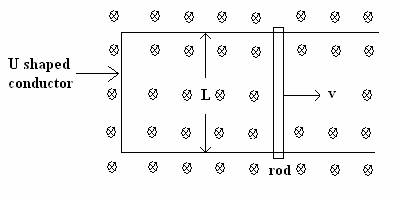
a crude generator by laying a movable conducting rod on a U shaped
conductor. In this setup, a uniform
magnetic field is perpendicular to the area bounded by the U shaped
conductor and moving rod. The U shaped conductor and moving rod create a
closed conducting path for current. The
length of the
moving rod and width of U shaped conductor is L = 15.0 cm. The student pulls the
rod to the right at speed v = 20.0 cm/s. The magnetic field has magnitude B = 0.800 T
and points in.
(a) (10 points)
What direction does the current flow
in the closed conducting path?
Indicate this direction by circling clockwise or counterclockwise
and drawing and arrow on the diagram above.
(b) (10 points) What is the magnitude |ε| of the induced
voltage (emf) between the ends of the rod?
(c) (5 points)
What is the magnitude E of the electric field felt by the electrons
in the rod? What is the direction of
this field? Indicate the direction with a labeled arrow.
SOLUTION:
(a) Counter-clockwise since the expanding area is like a field
externally increasing inward. Vector-Bind is
out to OPPOSE this change.
(b) BLV= (0.800 T)*(0.15 m)*(0.20 m) = 0.0240 (V)
(c) E*L = change in voltage; thus E = BLV/L = B*V = 0.160 (V/m) where
Vector -E points up.
----------------------------------------------------------------------------
2. ( 53 points) Below is a model for a pulsed
laser used in science
and medicine. The interior of
the pulse can represented by an
EM plane
wave with wavelength 1062 nm. Note: 1 nm = 10
-9 m. The
magnetic field  oscillates
vertically up
and down and has a magnitude of 7.00x10
-9 T .
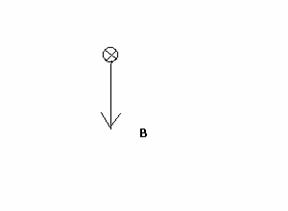
At a given instant the magnetic field vector points down as shown
in the diagram below. The downward arrow is labeled by the
magnitude B of the magnetic field .
As shown by the circle with crossbars,
the wave’s propagation
direction is into the page. oscillates
vertically up
and down and has a magnitude of 7.00x10
-9 T .
At a given instant the magnetic field vector points down as shown
in the diagram below. The downward arrow is labeled by the
magnitude B of the magnetic field .
As shown by the circle with crossbars,
the wave’s propagation
direction is into the page.
(a)
(14 points) At
the instant described by the diagram, what is the direction of the electric field  ? Indicate this
direction by drawing an arrow symbol on the diagram below. ? Indicate this
direction by drawing an arrow symbol on the diagram below.
(b)
(14 points) What is the magnitude of the electric field?
(c) (5 points) What
is the frequency f of this electromagnetic wave?
(d) (20 points) If the pulse lasts for 16x10 -12
seconds, then what is
the length (in meters) of
the pulse?
SOLUTION:
(a) The electric field points horizontally to the right. Point your
right fingers in the electric field direction and WRAP your fingers into the
B-vector, and you thumb points in , in the direction of the propagation.
(b) E =c*B = (3.00x10⁸ m/s)*(7x10-9T) = 2.1 V/m.
(c) f = c/lambda = c/wavelength =
(3.00x10⁸ m/s)/(1062x10-9m) =- 2.82x10¹⁴
Hz.
(d) length = c*t = (
3.00x10⁸ m/s)*(16x10 -12 s)
= 0.0048 m = 4.8 mm.
---------------------------------------------------------------------------------------
3. (38 points) A person stands in front of a mirror
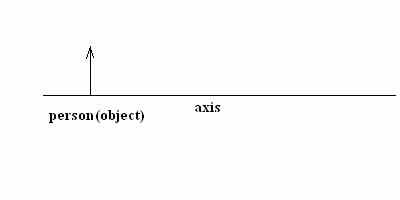
at an amusement park. In the diagram below, the person (the object) is shown
and to the right is a mirror, not shown. The mirror shows an upright image (not shown) of the person
that seems to be 4.0 meters behind the
mirror. Assume the image is 3.5 times
the person’s (object’s) height .
(a) (2 points)
Is the image virtual or real?
Explain.
(b) (28 points) What is the focal length of the mirror?
(c) (4 points)
Is the mirror concave or
convex ?
(d) (4 points) On the diagram above sketch the mirror on
the right of the person (object). Draw
the image by ray racing as we did in class. Ray trace by drawing two rays
from the tip of the arrow, one parallel to the axis and the other
intersecting the
point where the mirror crosses the axis. Label the object
distance do and image distance di.
SOLUTION:
(a) Obviously the image is virtual because
the image is behind the mirror; this is true in the case of a flat
mirror or a curved mirror.
(b) 1/f = 1/do + 1/di where we need do. Note di = -4.0 m and the magnification m = + 3.5 = -di/do. Thus, solve for do = -(-4.0 m)/(3.5) = 1.1429. Thus
1/f = 1/(1.1429 m) + (-1/4.0 m) or f =
(1.1429)*(4.0)/(4.0 - 1.1429) = 1.6 (m).
Concave since f > 0.
(d) See class
notes or check out figure 23.16 and COMPARE with figure 23.14.
--------------------------------------------------------------------------------
4. (37 points) A
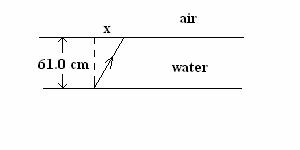
beam of light is emitted in a pool of water (n = 1.33) from a depth of 61.0
cm. The light ray strikes the surface a horizontal distance x from the spot
directly above the light source as shown in the diagram below. For air, the index of refraction is nair =1.
SHOW WORK.
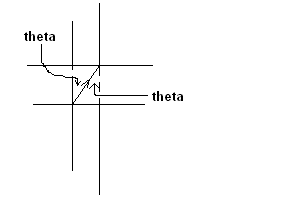
(a) (19 points) Suppose
the beam strikes the
water – air surface a horizontal distance 112.5 cm from the spot directly above the light
source. Will the light exit the water ? Answer yes
or no. If yes, give the angle the beam makes with the normal after it exits
the water into the air (nair =1). Diagram
the problem in the white spaces below.
(b) (18 points) Suppose
the beam strikes the
water – air surface a horizontal distance 45.7 cm from the spot directly
above the light source. Will the light exit the water ?
Answer yes or no. If yes, give the angle the beam makes with the normal after
it exits the water into the air (nair =1). Diagram the problem in the white spaces
below.
SOLUTION:
Your main task should be finding the critical angle; after that procedure,
everything else falls in place.
Sin θc = (1/1.33) giving = 48.75 degrees. You can also
beforehand
compute tan theta = x/61.0 cm; yo, theta is the incident angle on the
water side and if theta > θc, the light will NOT exit.
(a) theta = tan -1 ( 112.5/61.0) = 61.5 degrees > θc
so light will not exit.
(b) theta = tan -1 (45.7/61.0) = 36.83
degrees <θc , so it exits and you can find the exit angle in the
following way using Snell's law:
(1.33)*sin 36.38
= (1)*sin theta_f, where theta_f is the final exit angle. See #30, Ch. 23
for practice with this concept in preparation for the final examination .
In any event, the exit angle is theta_f = 52. 8 degrees.
|