update #1: Problem 2. The word "wheel" was replaced by "ball" since we are referring to a rolling ball in the form of a solid  sphere . There are such things as spherical  wheels, but I'd thought I'd change the wording for  maximum clarity. 

1.  A wheel experiences the three forces below at some instant in time. Each force is directed tangent to the circle on which it is applied. The distance between the axis of rotation (at the center) and the inner circle is 0.12 m. The distance between the center  and the outer circle is
0.24 m.
(a)  (15) Calculate the magnitude || of the net torque about the axle of the wheel shown below.
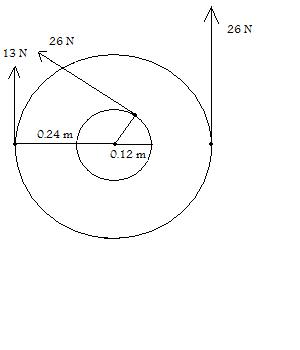
(b) (5) Assuming the wheel  starts from rest,  what direction does the wheel begin to rotate,  clockwise or counter-clockwise? Circle one.
(c) (10) Assume the moment of inertia about  the center is I =
0.250 kg-m2. What is the angular acceleration  at that instant?
(d) (8)  What is the  angular velocity ω  after a time period of 10.0 seconds?
(e) (8) How many revolutions does the wheel turn after 10.0 seconds?


2.  (20) A bowling ball of mass M  in the shape of a  uniform solid sphere  rolls without slipping along the horizontal  ground at linear velocity  VCM  = 3.2 m/s. You  are ignoring the  grip hole’s influence on I.  The ball’s radius is R = 9.0 cm. 

(a) ( 15) If the  total kinetic energy of the ball is 55 J, what is the ball’s mass M?
(b) (5) How many revolutions does the ball turn about its center in 5.0 seconds?


3. ( 35)  A rotating disk of moment of inertia I and angular velocity ω is dropped on an identical disk rotating with angular velocity 3·ω.  Use symbols in this problem. They stick together after the collision. 

(20) Assuming no external torques, what is the final angular  velocity ωf of the two disks after the collision?
(5) What is the kinetic energy of the system before the collision?
(5) What is the kinetic energy of the system after  the collision?

(5) Using symbols,  write the expression for the heat energy released during the collision.


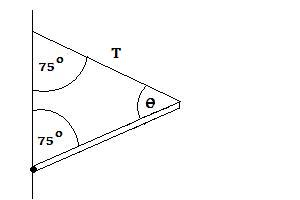
4.  A  30-kg beam (i) is supported by a   wire  at its  right end and (ii) is attached to a vertical wall  at its  left.

(a) (10  points)  What is the angle ?
(b) (20 points) What is the magnitude T of the tension in the wire?
(c)  Extra Credit. (6 points)  What is the horizontal component Fh of the force exerted by the wall on the beam’s left end?

(d)) Extra Credit.  (8 points)  What is the vertical component Fv of the force exerted by the wall on the beam’s left end?


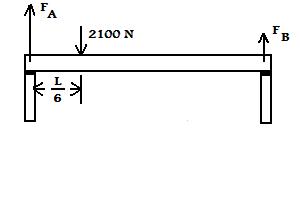
5.  Calculate  FA and FB for the beam shown below. The downward force is the weight of machinery on the beam. The beam length is L. The machinery force  is applied a distance L/6 from the left end. Assume the beam is uniform and has a mass of 250 kg.

(a) (15 points) Compute   FB.
(b) (15 points) Compute F A.


6.   A  piece of wood is placed in a vat of alcohol with density 700 kg/m3. When placed under the alcohol surface, the wood piece is  found to  sink downward with acceleration magnitude a = 0.90 m/s2.

(a) (30 points) What is the density of the wood?
(b) (5 points) Explain why the volume V of the wood piece was not needed to find its  density?
(c) (20) Assume V = 2.500x10⁻³ m3. What is the magnitude FB of the buoyant force ? What is the magnitude of the wood’s weight?


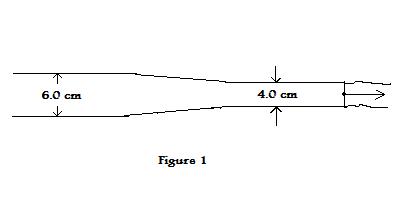
7.A 6.0-cm diameter  horizontal hose  with water  flowing   narrows to 4.0 cm at the right end shown below in figure 1.  At that end, where the water exits the hose,  the pressure is atmospheric pressure = PATM.  In the 6.0 cm section,  the pressure is 1.1·PATM.

(a)  (20  points) What is the volume rate of flow  A2·v2, where  A2 is the cross-sectional area  and v2 is the speed of the water at the left end?
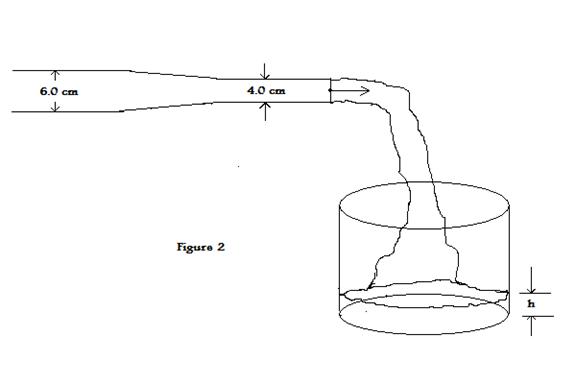
(b) (6  points) Suppose the water from the hose is used to fill an empty swimming pool that is 6.1 m in diameter as suggested in figure 2.  How long will it take the hose to fill the pool to a depth h of 1.2 m? Hint: The units of  A·v are m3/sec.